 Add to Chrome
 Add to Firefox
 Add to Edge
Learning Through Noise: Why Subliminal Learning Works and When It Fails
May 22, 2026
In the context of artificial neural networks, subliminal learning refers to the transfer of task-relevant knowledge or unintended biases from teacher to student models through distillation on task-unrelated input$\unicode{x2013}$output pairs. Prior explanations tie this effect to shared or closely matched teacher$\unicode{x2013}$student initialization. We show that a closely matched initialization is not necessary. Instead, subliminal learning is governed by compatible output heads. Using a controlled MNIST setting, we split outputs into an auxiliary head (for auxiliary, task-unrelated noise signals) and a class head (for classification) to demonstrate subliminal learning occurs$\unicode{x2014}$even when we randomly initialize hidden layers and remove layers, add new layers, or change the architecture (MLP-to-CNN). Compatible auxiliary heads enable transfer of a recoverable teacher signal, bringing the student's representations closer to the teacher's. When the class heads remain compatible as well, students trained only on task-unrelated noise can approach, and in favorable regimes match, teacher-level task performance. Our setting enables us to develop a theory that explains the mechanism of subliminal learning and to derive upper bounds on when subliminal learning fails. Together, our results turn subliminal learning from a surprising transfer effect into a theoretically grounded mechanism with predictable limits.

What should a neuron aim for? Designing local objective functions based on information theory
Dec 03, 2024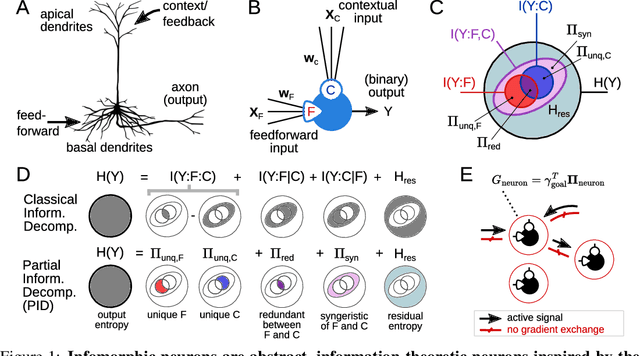
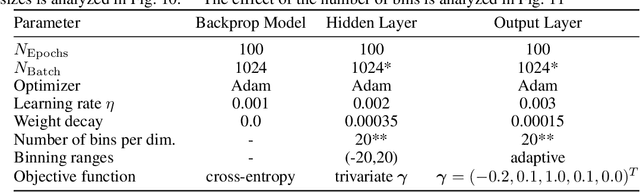
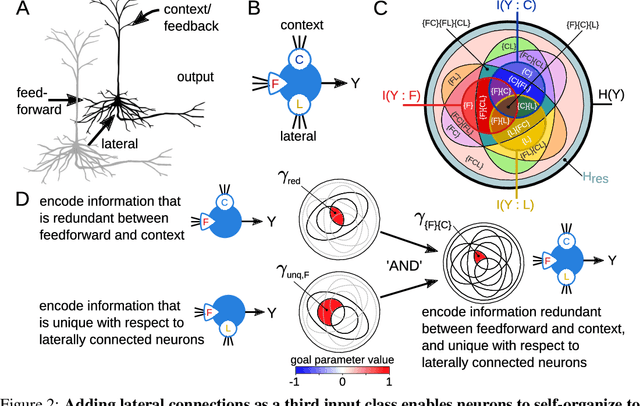
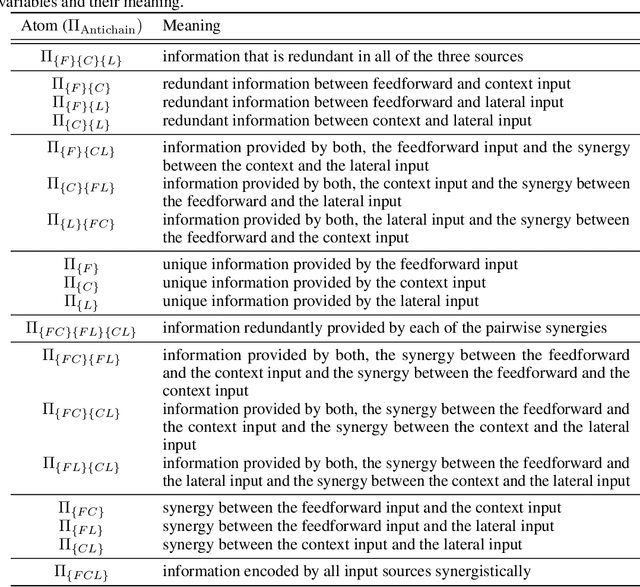
In modern deep neural networks, the learning dynamics of the individual neurons is often obscure, as the networks are trained via global optimization. Conversely, biological systems build on self-organized, local learning, achieving robustness and efficiency with limited global information. We here show how self-organization between individual artificial neurons can be achieved by designing abstract bio-inspired local learning goals. These goals are parameterized using a recent extension of information theory, Partial Information Decomposition (PID), which decomposes the information that a set of information sources holds about an outcome into unique, redundant and synergistic contributions. Our framework enables neurons to locally shape the integration of information from various input classes, i.e. feedforward, feedback, and lateral, by selecting which of the three inputs should contribute uniquely, redundantly or synergistically to the output. This selection is expressed as a weighted sum of PID terms, which, for a given problem, can be directly derived from intuitive reasoning or via numerical optimization, offering a window into understanding task-relevant local information processing. Achieving neuron-level interpretability while enabling strong performance using local learning, our work advances a principled information-theoretic foundation for local learning strategies.